I don’t think that’s reason to hand in your conservative card. Quite the opposite, in fact!
I’d even argue that the most staunch supporters of a liberal arts education are traditionally conservatives. We could probably save a lot of misconception if we just called it “social science, natural science and math” or “generalized intellectual curiosity”.
There was (not too long ago) and extended thread on this forum.
“Higher education, Takes too Long. Costs too Much. Too Little Practical Value.”
It was a long thread, and impossible for me to remember exactly who said what. Only a few of us, very few, made the mistake of equating the academic liberal arts with political liberalism. (There is little need to correct a misconception that is not being made.)
But I suspect if we revived it, or even looked through it, we would see the four-part truth I wrote above, and see that the conservative agenda for higher education typically does not leave much room for the liberal arts
By the time of Pliny the Elder, Rome was spending hundreds of millions of sesterces on silks and spices—roughly the same share of its budget as modern America spends on imported consumer goods.
That is far from the only econ student that Kirk has talked with. It may be the only video YOU have seen, but he isn’t the only one.
But don’t you find it just a bit disturbing that a guy that dropped out of college in his first year knew more than this guy who was either a junior or senior?
Oh wait, I forgot, Kirk had different views than you, so ANYTHING he said is to be discredited and criticized.
Yeah, I can only comment on the one posted. I don’t watch his videos regularly.
What makes you think Kirk knew more than the student? Because he named some authors that the kids program doesn’t cover? How does that equate to him knowing more than the student?
My point is, you can do that with literally any college level major - rattle off a bunch of authors not covered. I read somewhere around 100 books for my college degree and I promise you we didn’t touch on 100s of important authors because the field is just plan vast.
Depends on if it somehow correlates with the major. I went to college to get a business degree, why I had to take classes in theater or ancient greek mythology is well, odd. Thankfully I had quite a few credits accepted from my Associates degree so I only had to take a few “electives” Now I can understand why a class is sociology would be connected to a business major and thankfully my soc credit transferred over.
You can learn those same skills in coursework that can logically be tied to a business major. Sociology is a good example, you can learn empathy, problem solving, and critical thinking just from that class. I had to take a theater class where all we did was watch films and write avout what we saw, had to go to a performance by the theatee dept and write about specific aspects of the performance. What does any of that have to do with a business major?
I also had to take 2 history classes, being as I loved history and wanted to make it a minor, but the VA wouldn’t approve classes not listed specifically for my major, I was unable to do that. But, history is something every student should be required to take. I personally think electives should be somehow related to your major
Helps with critical thinking and analysis, hones written communication skills, understanding your audience, creativity and time management.
Of course you can sit in a classroom and learn the theory of these concepts but using a movie review format makes it for an interesting and effective method of practicing and using those skills.
History, ecomomics, military studies, earth/environmental studies,
lots and lots of folks would learn a lot from this 22-minute video from the same series. (It’s part of a course at U Arizona.)
.
.
.
1:30
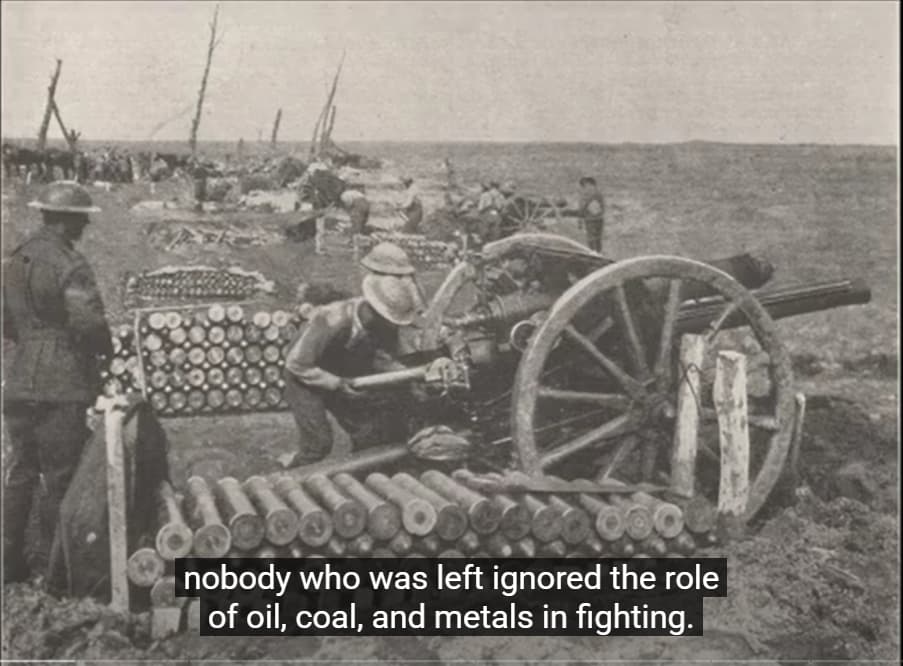
By 1918, with the heroics exhausted but the artillery still going,
nobody who was left ignored the role of oil, coal, and metals in fighting.
. . .
An American government committee compiled a list of 28 minerals
and other materials that had encountered supply difficulties during the war,
but little other action was taken amid the general wish to forget.
A relieved but exhausted world partied its way through the 1920s . . .
3:54
Philosophies of autarky, or national self-reliance with regard to raw materials, took hold. . . .
6:53
America was a major exporter of oil, copper, and molybdenum in the 1930s,
and produced plenty of iron and coal,
but imported
90% of its chromium,
86% of its manganese,
61% of its tungsten,
and the entirety of its nickel and aluminum from abroad.
Absent these metals, as Leith put it,
"If all our imports were cut off,
our industry would indeed return to the horse and buggy days.
We could build neither an automobile nor a battleship."
Theater and business for example…if, through your elective, you realize you have an appreciation for theater, you might be moved to get involved on the business side of the arts.
But as much as anything, I thin electives help you realize if you are majoring in the right thing.
Best to learn sooner than later that your true passion is sociology and not mathematics…