Milton Friedman is taught endlessly in just about every introductory macro course. The most prevalent textbook for principles level Macro starts with Friedman’s basic premise about inflation.
Thomas Sowell’s principles are taught in every introductory macro class. In fact, most textbooks use his definition of the field.
Undergrad economics courses focus primarily on theory and practice, not the people who created it.
Among the many conservative views of education the unifiers are that
there is too much prpaganda being taught, and
standards have been lowered to much.
Beyond that
there are some who champion a classical education,
and others who think only in-demand degrees (such as engineering and business and medicine) should be taught at all.
When I learned it, the same schools where economics is taught also had humantiies requirments (foreign languages, history, literature etc.).
In theory, that would have been a great place to have students in each major read the classics in their field
Econ majors woud read Smith, Mises, J B Say etc
Other majors would have read Archimedes, Euclid, Democritus etc..
I felt my own economics studies were lacking in the classical works,
so I read many of them myself. Then at the 400 level I found a professor willing proctor me in 3 credits in independent studies we called “A Guided Reading of MIses’ Human Action.”
.
.
.
Yes, I think most econ departments are wrong to give so little attention to the great minds of free market economics.
Yes, I think they have too much of a Keynesian bias. But I stop short of, in any way, wishing that my ideas become somehow REQUIRED. That whole notion "I think it’s a good idea so let’s make it required," strikes me as being, I dunno . . . Karen-esque?
We are not so far apart there. I’ve always felt that there should be two tracks in economics:
A quant track for people who want to go into finances or intensive economic modeling. A degree that walks the line between econ and stats.
A theory track that reads the most important texts from the most impactful economists across the spectrum. From Smith to Schumpeter and Mises to Keynes, Friedman etc… A degree where you dive into the history of economic thought - a genuine liberal arts degree that also requires coursework in sociology, anthropology…
Somewhere out there on the internet are the preliminary exams for UChicago graduate econ students in the 1950s and 1960s. There’s no math beyond some basic functions. It’s deep economic theory and writing.
I think we lost something when we handed the field over completely to quants.
I don’t dislike those ideas.
I was thinking more like:
Close most colleges to students who need remedial courses (in math).
That way Econ 101, 102 etc could all be taught the way they were before we watered things down.
Add, in some fashion, (couple ideas come to mind) an opportuntity for students in every major to study the classic works in their field.
That seems somehow inusfficient so, let’s call it a start.
Carl Menger was part of the marginal revolution, wasn’t he?
Man I’d probably fail the Intermediate macro at many universities these days. It’s a very hard class with a ton of calculus. I honestly don’t think it’s watered down.
And yes, I think every student who graduates with an econ degree - in quant or theory - should be required to read some of the classics. They should be exposed not just to modern thought, but the dead economists who gave us the scaffolding for that modern thought.
But for Menger I don’t think we’d have a marginal revolution (the real one, not the podcast. To my knowledge Menger never hosted podcasts)
You support a president who brags about his east coast ivy league education, and has not brought the weight of the federal government to bear on those institutions, as he has on others.
Kirk finds one student who isn’t studying econ they way HE would (the guy who decided college wasn’t for him) and suddenly that becomes a condemnation of the entire system.
I committed to you to remind you of my contempt for your posts each time you replied to me.
There is nothing to defend. Each time you respond to me, you remind me of the stupidity of your posts here. I see no value in explaining that stupidity to you. You demonstrate that you won’t understand it anyway.
Thus, all I can say is that you need to figure out how to avoid responding to my posts. I don’t expect you ever will.
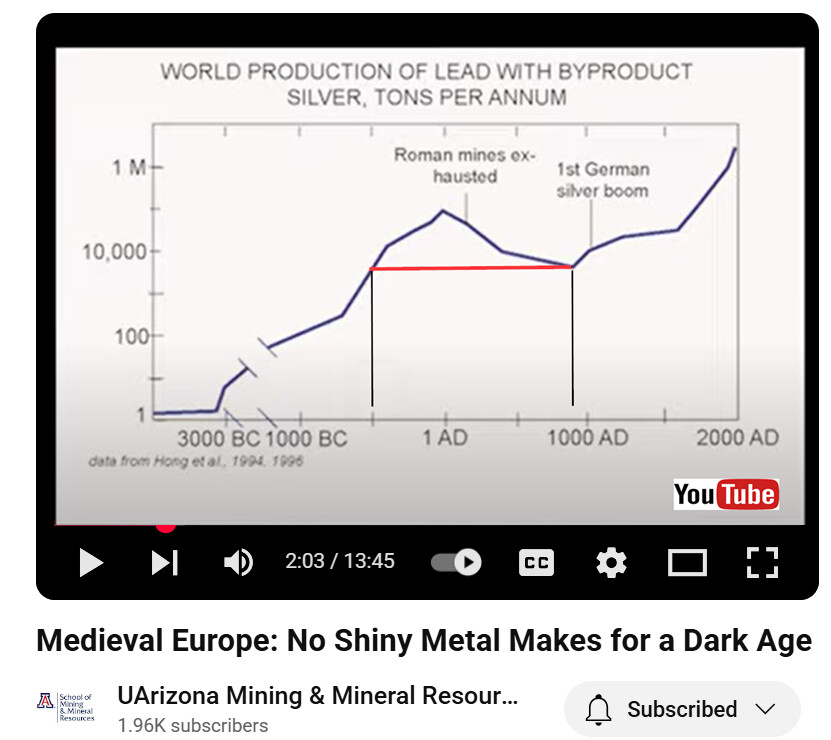
Watching this, will be one of the best 13-minute periods of your day.
Societies have used gold as money, silver as money,
tobacco as money, dried fish as money, etc..
There’s a catch though:
Whatever a society uses as money, they need enough of it. If they run out that thing, they have to replace it with some other thing or they have a broken currency system. (That would be bad.)
++++
Some geology chick at U Arizona believes that a broken currency system
was a big part of why Europe plunged into the Dark Ages.
Of course these days, the main focus of universities
is to train otherwise intelligent people to berate one another for using terms like"Dark Ages." (It isn’t politically correct and only poltically correct terms should be used), but she just dont care.
It means a broad spectrum of disciplines in a college degree. I, too, have an affinity for a degree that incorporates coursework outside one’s major.
I went to a liberal arts college. My biology and economics majors required almost 40% of my coursework in electives, including core curriculum in classics, English, literature, history and some others. Biology professors took off points for grammar and spelling in research papers.
A liberal arts degree demonstrates that the student can be educated in areas other than his favored discipline, that he has the ambition and focus to learn an area that doesn’t really excite him. He comes out of his college years well-rounded.
There is a huge difference between Liberal Arts and lib studies.
During my business degree, I had components on philosophy and art appreciation. At first I thought what the heck doea this have to do with business but as I completed them I understood why. These developed critical thinking, problem solving skills, ethical reasoning; empathy, visual communication skills snd creative and innovative thinking.
Plus it helped me become more aware of the world around me which is never a bad thing.