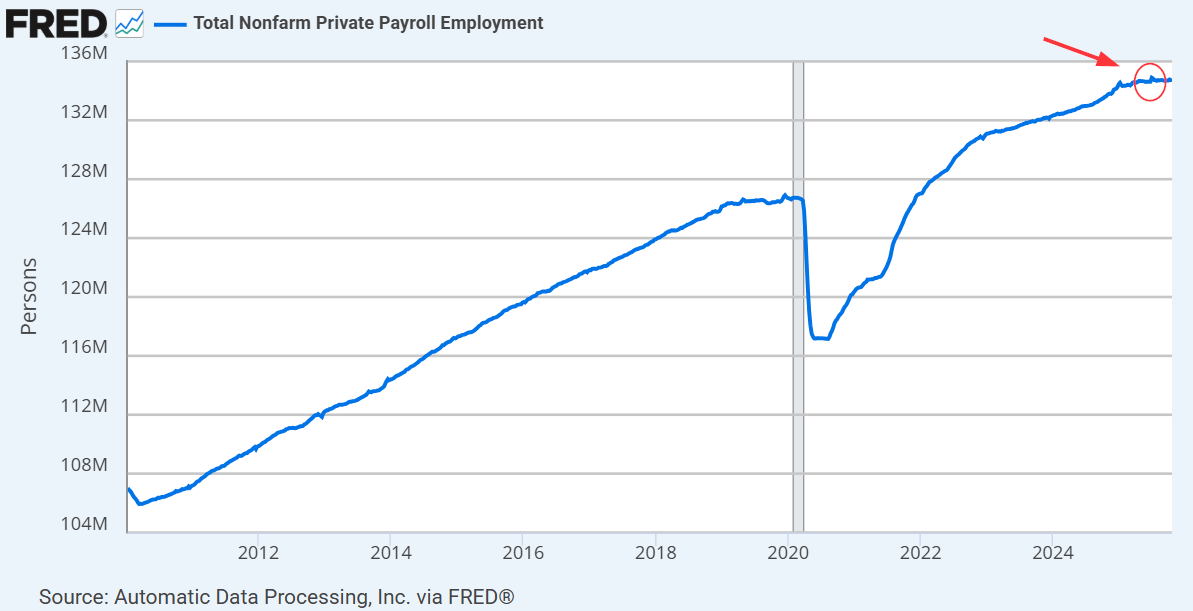
Of course if you beleive the claim in this thread - that the ADP decline is due to undocumented workers being removed - then it r follows that government policy is responsible. Government did the removing.
I understand ADP just fine, TYVM
Of course if you beleive the claim in this thread - that the ADP decline is due to undocumented workers being removed - then it r follows that government policy is responsible. Government did the removing.
I understand ADP just fine, TYVM
So the companies were behaving rationally by having an extra 40,000 people on payroll, but when government removed those 40,000 companies were also acting rationally when there was no labor shortage after?
That doesn’t sound like Adam Smith to me tbh.
That is possible, indeed plausible, but it is not a claim I have made (yet).
The tiny little bump we are discussing is most likely a non-occurrence. (statistical noise)
If we do need to find a culprit, it could very easily be
Or, of course, it could be that a decline of 32k in ADP is a fully meaningless statistic. Which it is, But folks here needed to explain it away (not you, but
others I was responding to)
May I play devil’s advocate?
BLS data shows that in the short time that Donald Trump has been President, 750,000 people have become unemployed.
(Jan-Sept, green arrow below).
I suggest that is a lot by some standards/
BLS data also tells us
1.4 million foreign-born employees left US payrolls
During the same time
(Jan-Sept, red arrow below).
Hypothesis:
Had it not been for the combination of Trump Tariffs and Trump deportations, unemployment would be quite a bit higher right now, and that would, in all probability, be causing a rapidly worsening trend in nearly all measurable aspects of the economy.
I think measured unemployment might be higher if we hadn’t exported a portion of the labor force, yes. But output and employment would both be higher.
You treat that as though the number of people who are nw working as replacements for the criminal workers is so smallas to be neglibible.
Which is better:
I treat what I stated as a simple outcome of a simple economic analysis.
Adam Smith seemed to think
An economy with 171.2 million people working
– is stronger than –
An economy with 171.2 million people working, plus 1.4 million unemployed people living on meager handouts.
Is that one of the points where Smith was wrong?
you said unemployment rate would be higher. I agreed and pointed out that employment and output would also be higher. That’s all I said.
I realize that. Your comment strikes me as being out of context, deceptive even.
I don’t find nor did I intend it to be either but that’s fine.
Well, employment and output would also be higher, but only in a gross sense,
If Adam Smith was right then, in a “net” sense, once we account for up 1.4 million additional umeployed, (simultaneously drawing down the public treasury AND trying to provide for their families on greatly-reduced incomes) the nation is more abundant as is, and would be less abundant if those criminals had remained employed.
Why would there be an additional 1.4M unemployed?
(UI doesn’t take from the public treasury, it’s an insurance system)
Not true, and I am surprised you did not know that.
During COVID, when UE payments went up, that money came out of the government’s till. Spending increased and the dericit increased. Tehy are “insurance” in name only.
Insurance is like life insurance. It is actuarially sound and has zero elements in common wiht a Ponzi scheme. If your private sector life insurance company never gets a new customer ever again, you still get your money. It is safe and invested and not relying on future pay-ins.
SS, Medicare, Federal UE, and state UE are the oppostie. Only a teeny tiny, itsy bitsy portion of the money needed is invested. These programs are not at all like insurance companies. They rely nearly 100% on people paying in.
They are not at all actuarially sound. They have almost nothing in common with insurance. Anyone in the private sector who did that and called it “insurance” would be jailed for fraud. KIng George and his appointees are above the law.
yes, when Unemployment gets high enough to deplete state coffers the federal government takes on the role of reinsurer. This is not the norm. It’s also not the norm to double or triple or quadruple payments via federal mandate like during COVID.
If your private sector life insurer never gets another customer you are ■■■■■■■ You will never see that money. You better hope, like UI, they have a reinsurer.
This is not a lack of "knowing"on my part. I think I understand the UI system just fine.
UI’s are not I’s. They are paygo.
Sometimes with a small truat fund (like SS)
Sometimes with effectively none (like medicare.)
Insurance, as I said,is actruarially sound.
If the company gets no new customers whatesover it is still sound, just like your bank.
Paygo is the opposite of insurance.
Insurance is the oppostie of paygo.
Those are not the smae, they are not even comaparable.
They are more nearly antonyms.
They are not. They are set up on actuarial basis to build enough reserves during expansions to pay benefits during contractions - And very conservative, at that. This isn’t AIG buying MBS’s.
Neither of those will remain sound without new customers. Banks would collapse in short order if they couldn’t make loans or get new deposits.
Were all the GFC banks and insurance companies “actuarially sound”?
The banks may collpase as businesses but the money you place in a bank is
—> Not used to pay current customers,
—> Itis instead put intoloand and bonds taht ay more than you are getting.
(Insurance works the same way.)
Wholly completely and 180 degrees different is the mony you put into meucare and UI.
Those were spent (not invested sent) days after you paid them in.
UI is paygo and by defintion paygo is not insurance.
The reason the money you place in the bank is there is because… Wait for it…
Government-sponsored insurance that is not always actuarially sound.
The money you deposit in a bank is used to pay current customers - Loaned out. (technically the loan and the deposit aren’t connected but on the books they are.)
Hannity Community
The official community forum of Sean Hannity. Join the conversation with fellow conservatives on the issues that matter most.