If you give me $100 and I agree to give your wife some super-huge unapayable amount ($1,000,000??) upon your death
- that congtract might be legal
- but callong it “insurance” would be an act of fraud.
If you give me $100 and I agree to give your wife some super-huge unapayable amount ($1,000,000??) upon your death
The key differnce however is what becomes of the money in the end.
If you give me $900k and I agree to give your wife $1m upon your demise,
it makes a BIG difference if then
That is the frawework of an insurance contract.It is legal. If you make the same offer to a pool of people it’s insurance.
The UI trust fund of each state collects premiums from thousands (millions) of firms. The UI division in each state estimates what fraction of those will require payments. It sets rates accordingly.
The car insurance companies in each state collect premiums from thousands (millions) of car owners. The car insurance companies in each state estimate what fraction of those will require payments. Then they set rates accordingly.
The home owners insurance companies in each state collect premiums from thousands (millions) of home owners. The car insurance companies in each state estimate what fraction of those will require payments. Then they set rates accordingly.
In each case, at times events that impact a broader share of claimants than expected make the companies temporarily insolvent.
No.
That is a necessary but insufficient condition.
Private companies are not allowed to spend the money; they must invest he money. If they do not invest the money, they are not selling insurance and saying they are is an act of criminal fraud.
The test is a simple one.
Could a private company do exactly the same thing and legally declare, “I am selling insurance.”
.
.
.
.
State gov’t spends the money on sandwiches —> Not legal for private actors = not insurance
State gov’t transfers it to a non-arms-length entity, which then spends it on sandwiches —> Not legal for private actors = not insurance
State invests the money (EX in diversified gov’t bonds bought on the open market and sold on the open market) —> Yes, legal for private actors = Yes insurance.
State transfers it to an entity that invests—> Yes, legal for private actors = Yes insurance.
The UI trust fund does not spend the money. It invests the money in nontransferable securities. You seem to have a concern with what the issuer of that security does with the funds. I have no such concern because that issuer has a 100% track record.
Either way, it’s not fraud and the private sector does the same thing - in fact, I’d bet the plurality of private sector insurance fund investments are in Treasuries.
Well Copilot is not a legal expert
but just for reference (Copilot DOES at least does not use strawmen, feigned ignorance etc
Here is the converastion staright up
Q (from Gaius):
Can a private sector insurance company legally stay open if it invests none of its premium payments but instead takes 100% of the money and either spends it on consumables or donates it to charity?A (from Copilot):
Short Answer: No. A private sector insurance company cannot legally operate this way. Insurance law requires companies to maintain statutory reserves and comply with strict investment regulations to ensure they can pay claims. Spending or donating 100% of premiums without maintaining reserves or investments would violate solvency requirements and lead regulators to shut the company down
Q (from Gaius):
If a private person or company did something like that would it be a jailable offense?A (from Copilot):
If a private person or company collects money under the guise of insurance but then spends or donates all of it without maintaining reserves or the ability to pay claims, that crosses into fraud and misappropriation of funds.Fraudulent Misrepresentation: Selling “insurance” while knowing you cannot pay claims is fraud. Fraud is a criminal offense and can carry jail time. . . .
This is the straw man / false premise. State U trust funds invest the money. It’s held in a federal account and earns interest. It is paid out in cases where insurance is required.
You just don’t like the investment vehicle.
Not an arms-length transaction.
That is not a term made up.
It is a legal/business term and applies always and to buinses transactions always and everywhere . . . . except that some people want us to put blinders on when it comes to government.
A transaction between two family members, a company and its subisidiary or, in this case, two levels of gov’t is not an arms-length transaction.
Maybe . . .
Possibly . . .
Imaginably . . .
If those state govenments bought regular, salable Federal bonds on the open market,
then perhaps . . . .hyopthetically . . . . it could be considered an actual transaction. As is, it does not even rise to the level of moving money from one pocket to another.
It’s not a made up term. It also doesn’t apply here.
States and the Feds are not family members. They are not subsidiaries (hello, 10th amendment and federalism!).
But that’s not at all what UI does. It collects money from you regularly with the promise to give you some small amount of that back should you need it.
A vast majority of people don’t ever need what they pay into the system.
There is no 100X the investment payout like traditional life insurance.
UI funds can’t be used for anything but UI claims. They are invested funds.
If not treasuries, what would you have them invest in?
If they don’t call it insurance, they can invest in anything they want or in nothing at all.
Having an Unemployment program that is NOT insurance?
—> Well, I don’t like it, but we have done worse.
Having an unemployment program that is NOT insurance
and people (professors, textbooks, college professors, etc) turning a blind eye and claiming insurance?
—> I seriously don’t like that. That is a SERIOUS problem that will cause other bad decisions based on bad information. We seriously should stop doing. We really should face reality and stop running up bills for the next generation to pay.
The problem with boomerism is sooner or later we run out of other generations’ money.
Maybe the problem here isn’t the textbooks, it’s the person who failed to understand them.
UI is a state insurance system - pooled risk for uncommon events with excess capital invested - With the investment coming in a fund you don’t happen to like.
That doesn’t change what it is, it just means you don’t like the investment vehicle.
[quote=“7426k, post:216, topic:250176”]
Maybe the problem here isn’t the textbooks, it’s the person who failed to understand them.[/quote]
Ooohhh touche’
No, I understand the textbooks fine.
I choose not to believe them. I question what I read, and sometimes, I find it lacking.
The books read “UI is insurance,” meanwhile,
they had to come up with a whole new definition of “insurance” to call it that.
—> Always and everywhere insurance requires pooled risk (which you keep repeating), and some other things. Pooled risk is not a sufficient definition.
Pooled risk and a method to cover losses for individuals who experience the downside risk. That’s a necessary and sufficient definition of insurance. Unless of course you’re trying to obfuscate.
Is UI pooled risk? Does it pool reserves to fund payments to individuals who experience downside risk? Yes and Yes.
Is the FDIC pooled risk with a reserve fund to fund payments? Yes and Yes.
Is auto insurance… Yes and yes.
See a pattern here?
Well believe it or not Insurance companies selling insurance by any other defintion need that insurance to meet more criteria than just pooled risk.
The definton of insurace as it is used in every other circumstance must meet eight or more criteria including
1 pooled risk
2 reserves,
3 solvency,
4 insurable interest
5 utmost good faith
6 indemnity,
7 subrogation, and
8 contribution.
but hey . . a few out of 8 ain’t bad right?
A UI fund pools risk
It maintains reserves - both at the state and at the Federal government pool.
It is solvent
It is certainly insurable interest.
It is done in utmost good faith (unless you start from the premise it’s a Ponzi Scheme)
It is idemnified - certainly a party has agreed to cover payments.
It is subrogated - entire offices are setup in each state to pursue it.
And every time a covered firm pays a wage they contribute to the fund.
So you were saying what exactly?
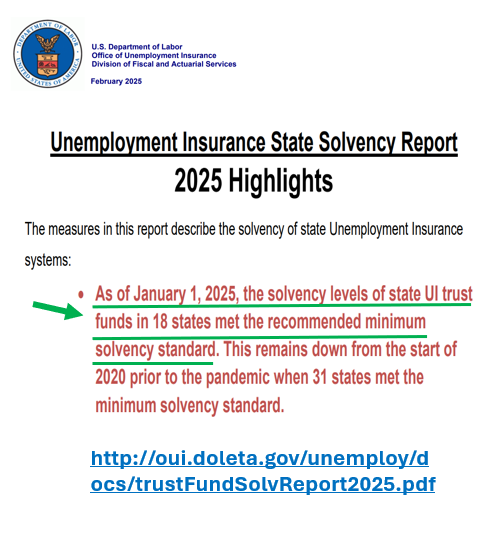
The DOL the CBO and I are all saying (in perfect agreement):
I am adding to that:
By the conventional definition of insurance, our unemployment programs are not insurance at all. They might be great programs, but they are not insurance. They are just another tax-and-spend.
The Federal government is the sole recipient of all funds paid-in,
invests virtually none of the money. It spends it all.
What would you prefer they invest in?
Hannity Community
The official community forum of Sean Hannity. Join the conversation with fellow conservatives on the issues that matter most.